Cebu’s international school shortlist is shorter than most expat parents expect, and one fact about it explains more than any tuition table: of the five schools that handle most expat enrollment, exactly one publishes what it charges.
Cebu International School posts a full fee schedule, grade by grade, as a downloadable PDF. Singapore School Cebu publishes its entry costs but not its tuition. Bright Academy runs a page titled “Tuition Fees” that contains no figures and tells you to email admissions. MMIS publishes nothing. USC does not put basic-education tuition online at all.
So this guide prints CIS’s numbers in full, because CIS published them, and prints no tuition number for the other four, because they did not. Every peso figure circulating online for those four schools traces back to third-party listings and marketing pages, not to a registrar. We used to carry those figures too. We have removed them.
The five schools that matter
| School | Where and what | What the school publishes | Calendar |
|---|---|---|---|
| Cebu International School | Pit-os, Cebu City. IB PYP, MYP, DP. | Full fee schedule by grade, plus discounts, EAL and learning-support fees | August start |
| Singapore School Cebu | A.S. Fortuna, Mandaue. Singapore MOE, Cambridge IGCSE, IB DP. | Entry costs only: processing fee, School Developmental Fee, reservation fee. No tuition. | January start |
| Bright Academy | Gov. Cuenco Ave, Banilad. US-style K-12. | Nothing. Its Tuition Fees page carries no figures. | August start |
| MMIS | Talamban and Gorordo Ave. Montessori, preschool to Senior High. | Nothing. | August start |
| USC North Campus | Gen. Maxilom Ave, Lahug. English-medium PH K-12. | Nothing online for basic education. | August start |
Cebu International School (CIS), Pit-os
CIS sits on a purpose-built campus in Pit-os, north of Talamban up Gov. M. Cuenco Avenue. It describes itself as the only IB Continuum school in the Philippines, offering the Primary Years, Middle Years, and Diploma Programmes (CIS Admissions FAQ). We could not independently confirm the authorization status of each programme at the IB’s own school directory, which blocks automated retrieval, so that description is CIS’s, attributed to CIS.
What CIS charges (SY 2025-26, school-published). The fee schedule is a two-currency structure: a peso fee, and an annual Dollar Fee in USD.
| Grade | Dollar Fee (USD) | Peso fee, returning | Peso fee, new student |
|---|---|---|---|
| EY2 / EY3 | $1,124 | ₱550,676 | ₱550,676 |
| Kindergarten | $2,025 | ₱606,122 | ₱665,673 |
| Grade 1 | $2,025 | ₱546,571 | ₱665,673 |
| Grades 2-3 | $3,453 | ₱661,492 | ₱822,518 |
| Grades 4-5 | $3,453 | ₱667,568 | ₱893,027 |
| Grades 6-8 | $3,705 | ₱766,423 | ₱1,088,473 |
| Grades 9-10 | $3,705 | ₱1,017,136 | ₱1,339,186 |
| Grades 11-12 | $3,705 | ₱1,041,668 | ₱1,363,718 |
The headline is not the price. For a new Grade 4-5 student, CIS’s own breakdown is Tuition Fee ₱406,140 (SY 2025-26), Development Fee ₱261,428 (SY 2025-26), and Entrance Fee ₱225,459 (SY 2025-26). The line labelled “Tuition Fee” is 45% of the peso total, and the peso total still excludes the Dollar Fee. Any parent comparing schools on a tuition number alone is comparing the smaller half.
The Dollar Fee and the BSP rate. CIS charges an annual fee in USD so it can pay its dollar bills, and it gives families the option to pay that fee in pesos “using the BSP exchange rate of the day,” linking BSP’s own reference-rate page in the fee schedule itself. That makes the peso cost of a CIS education move with the peso. The reference rate we track is ₱62.49/USD (BSP RERB, 10 Sep 2026), and the series behind it is published at /data/php-fx-rates. A Grade 11 Dollar Fee of USD 3,705 is a materially different peso number at 57 than at 62, which is why we will not print a converted figure that goes stale the week the peso moves.
Discounts, published. 5.0% off the total peso fee for early payment; 5% for the third and subsequent enrolled dependents in one family. Late payment carries a PHP 500 penalty plus 2% per month, compounded.
The fees nobody budgets for. CIS publishes a one-time English as an Additional Language fee assessed at admissions from its own English assessment: ₱280,900 (SY 2025-26) at Beginner level, ₱167,200 (SY 2025-26) Intermediate, ₱114,800 (SY 2025-26) Advanced. Additional Learning Support runs ₱48,000 (SY 2025-26) a year on a formal IEP, ₱28,000 (SY 2025-26) for in-class support without one. A Beginner-level EAL assessment is a bigger one-time hit than a year of tuition at most Filipino private schools, and a family arriving from a non-English school system can be assessed into it. This is the single most under-discussed number in Cebu international schooling, and CIS deserves credit for printing it.
What CIS does not publish. Transport is “by an outside provider (optional, at cost)” with no figure. A Homeroom Fund is “levied on all students” with no figure. After-school clubs, educational travel, and IB external exam fees are all “advised upon enrolment.” So we cannot cost a school bus or an IB exam sitting for you, and we will not guess at them. Note also that CIS states the elementary fee is “inclusive of basic school supplies which are provided by the school,” so a separate books-and-supplies line at primary level is double-counting.
Class size. Early Years caps at 14. Primary, Middle Years, and Diploma run 20 to 24 per class (CIS Admissions FAQ).
Who it fits. Families re-entering the US, UK, Australian, or Canadian university systems; families on multi-country postings where IB continuity matters; senior expat staff in the IT Park corporate and consular community, where CIS is the default. Less of a fit for a family whose ceiling is under a million pesos, or for a child who needs a more structured, less inquiry-driven primary curriculum.
Singapore School Cebu (SSC), Mandaue
Singapore School Cebu on A.S. Fortuna Street is the only Singaporean-curriculum school in Cebu. Preschool through Lower Secondary runs the Singapore MOE track, Upper Secondary moves to Cambridge IGCSE, and an IB Diploma option sits on top. It is the one path in Cebu that keeps a child on a single recognizable transcript from Primary 1 to Year 12.
SSC does not publish tuition. It does publish its entry costs, and for SY 2026-27 they are specific (SSC admissions): a processing fee of ₱10,000 (SY 2026-27) at Preschool, ₱13,000 (SY 2026-27) at Primary, and ₱15,000 (SY 2026-27) at Secondary and Pre-University; a one-time School Developmental Fee on acceptance of ₱80,000 (SY 2026-27) (Preschool entry), ₱160,000 (SY 2026-27) (Primary entry), or ₱200,000 (SY 2026-27) (Secondary and Pre-U entry); and a ₱50,000 (SY 2026-27) reservation fee credited against materials.
That means a family entering at Secondary faces PHP 215,000 in processing and developmental fees before a single tuition invoice arrives, and the tuition invoice itself is a number you can only get by asking. Budget the entry year well above the steady-state year, and get the tuition figure in writing before you pay the reservation fee.
Calendar. January start, aligned to Singapore’s MOE year. This is the main mismatch in the Cebu market and it matters most for a family relocating from Singapore mid-year.
Who it fits. Families with Singapore, Malaysia, or Hong Kong ties; families in Mandaue, Mactan, or Consolacion who want to avoid the Pit-os drive; families who rate primary-grade math rigor above the IB PYP inquiry model.
Bright Academy, Banilad
Bright Academy on Gov. Cuenco Avenue runs Grade School, Junior High, and Senior High for a multinational student body, on the Philippine K-12 framework with US-style teaching layered on top.
Its website has a page called “Tuition Fees.” That page publishes no fee. It states that “school fees will vary depending on the year level of the child” and gives an email address. That is the whole disclosure. We have seen a peso range for Bright quoted widely online; it does not come from Bright, and we no longer carry it.
Who it fits. Families who want a US-shaped education without the CIS price point, and who are willing to run the inquiry to find out what that price point is; families in IT Park, Lahug, Banilad, or Mabolo, where the commute stays under 20 minutes.
Maria Montessori International School (MMIS), Talamban and Gorordo
MMIS runs two campuses, Talamban and Gorordo Avenue, on the Montessori method from preschool through Senior High. It publishes no tuition figures for any level on any campus.
The honest caveat has nothing to do with price: pure Montessori at Senior High is thin globally, and families who want IGCSE or IB at upper secondary tend to move a child before Grade 9. Plan the exit at entry, not at 15.
University of San Carlos (USC) North Campus, Lahug
USC North Campus on Gen. Maxilom Avenue is not an international school. It is the basic-education arm of one of Cebu’s leading Filipino private universities: English-medium K-12 with STEM, ABM, and HUMSS Senior High tracks, at Filipino private-school pricing rather than international pricing.
USC does not publish basic-education tuition online. It is materially cheaper than the four schools above; we cannot tell you by how much without a number from the registrar, and we are not going to invent one.
Who it fits. Dual-national families, Filipino-heritage expats, families planning a long Philippine residency, and families whose child will likely continue at a Philippine university. USC Senior High articulates directly into USC’s own undergraduate programmes.
The schools we did not list
A handful of other Cebu schools admit foreign students each year and may suit a specific family: Sacred Heart School - Ateneo de Cebu in Mandaue (Jesuit, Chinese-Filipino K-12); Cebu Japanese School and Cebu Mandarin Chinese School, for families whose child returns to Japan or Greater China for senior secondary; Don Bosco Technology Center in Punta Princesa on a TVET track; USJ-R Basic Education and USC’s South and Talamban basic-ed campuses; and several small Christian schools chosen mainly by missionary and pastoral families. None of them is the volume choice for expat-relocation traffic, which is why the five above get the ink.
What you actually pay per year
Only one school in Cebu lets you build this stack from published numbers. Here it is, for the grade in the middle of the range.
| Category | Range | Notes |
|---|---|---|
| Tuition Fee (Grades 4-5) | ₱406,140–₱406,140 | 45% of the peso total. The headline number. |
| Development Fee | ₱261,428–₱261,428 | Annual, charged to returning students too |
| Entrance Fee | ₱225,459–₱225,459 | One-time, new students only. A returning G4-5 family pays ₱667,568. |
| Application fee | ₱12,000–₱12,000 | New students, non-refundable |
| Total | ₱905,027–₱905,027 |
Cebu International School, School Fees 2025-2026 (cis.edu.ph/uploads/FEES-SY2526.pdf). Excludes the annual Dollar Fee of USD 3,453 for this grade band, payable in USD or in pesos at the BSP rate of the day. Excludes the ₱50,000 reservation fee, which is non-refundable but deductible from tuition. Excludes transport, Homeroom Fund, clubs, educational travel, and IB exam fees, none of which CIS publishes.
Two things fall out of that table. First, the fee CIS calls tuition is under half the peso bill, and the peso bill is not the whole bill. Second, everything the school does not publish sits outside the total, and there is no honest way to close that hole with an estimate. A parent who wants a true all-in figure has to ask the registrar for the Homeroom Fund, the transport contract, and the IB external-exam schedule, in writing, before the first invoice cycle.
Admissions and the Special Study Permit
The sequence is consistent across the top four schools: inquiry and campus visit, application with prior school records, an entry assessment, a decision (CIS states its admissions process generally takes one week from a complete application), a non-refundable deposit that commits the seat, visa or permit processing, medical clearance, then uniforms and orientation.
What the Bureau of Immigration actually publishes
The SSP rules are usually stated with a confidence the BI’s own website does not support. Here is the published text, and the holes in it.
The eligibility line. BI’s SSP service page says exactly one thing about who it is for: “Foreign nationals who do not qualify for a Student Visa may still avail themselves of special study permit” (immigration.gov.ph).
The fee. BI publishes the SSP as a stack of line items totalling ₱5,240 (BI published schedule) plus USD 50 for the I-Card. That schedule carries BI’s own footnote: fees are updated as of 06 March 2014 and may change without prior notice. Quote it with the caveat or do not quote it. Schools that process the SSP on a family’s behalf add a handling fee on top; none of the five publishes what that handling fee is.
If you came to Cebu on a tourist visa specifically to place a child in school, map the longer-term visa path now rather than at renewal. The Cebu visa options guide covers 13(a), 9(g), and SRRV and the conversion mechanics. A permit buys time; it is not a destination.
The calendar trap
Do not assume the international schools track the Philippine public system. They no longer do, and the gap just widened.
Under DepEd Order No. 009, s. 2026, basic education moved to a three-term school calendar: SY 2026-27 opens 8 June 2026 and closes 8 April 2027, across 201 class days. That is the public-school year. CIS runs an August-to-June year, and its own SY 2025-26 fee schedule sets quarterly payment dates of 1 October, 3 December, and 4 March, which is what an August start looks like from the finance office. Singapore School Cebu starts in January on the Singapore MOE calendar.
Practically: land in Cebu 6 to 8 weeks before Day One. That window absorbs the entry assessment, the permit or visa step, medical clearance, uniform fittings, and a lease signed against the actual commute rather than a guess at it.
How school choice steers where you live
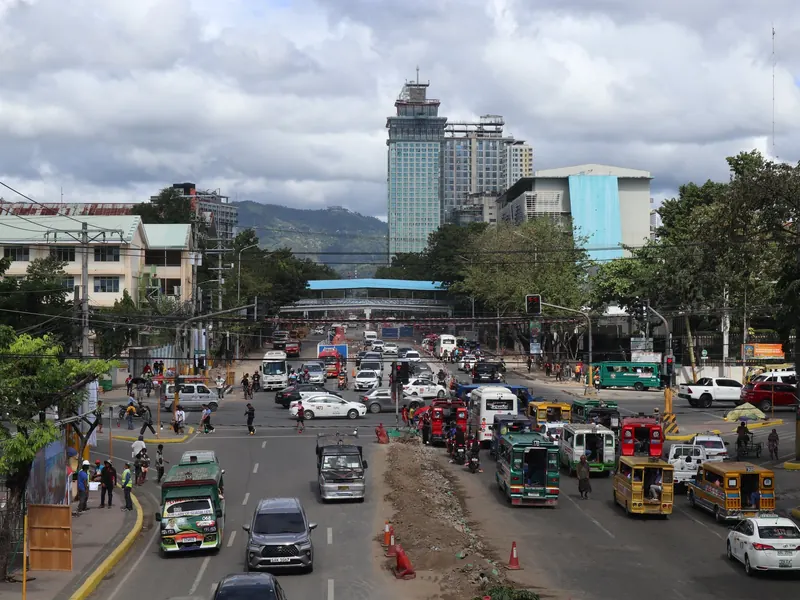
Cebu is compact, but rush-hour traffic compounds across a school week. Match the school to the neighborhood before you sign a lease, not after.
CIS in Pit-os is the hardest commute in the set. From IT Park at 7 AM the drive up Gov. M. Cuenco is 25 to 40 minutes. From Maria Luisa Park, Beverly Hills, or upper Nivel Hills, 10 to 20. From Mandaue or Mabolo at 7 AM, 35 to 55, and the school-run bus clears the corridor by leaving around 6:30. Families committed to CIS overwhelmingly land in Talamban, Banilad, or the upper-Lahug subdivisions. The Banilad and Talamban deep-dive covers the rental tiers there.
Singapore School Cebu pulls toward Mandaue, Consolacion, Liloan, Mactan, or the Mabolo-Mandaue border. From IT Park or Banilad at 7 AM, 25 to 40 minutes; from Mactan Newtown, bridge traffic can push it to 45 to 60. The Mandaue guide covers that catchment.
Bright Academy and MMIS Gorordo are the most central. IT Park, Lahug, Mabolo, and Banilad families see 10 to 20 minutes. Afternoon pickup runs straight into central-Cebu congestion, which is the real price of the central location. The IT Park and Lahug guide handles the residential side.
USC North on Gen. Maxilom is walkable from Capitol and lower Lahug, and families in that zone often choose it precisely because the school sits on the daily walk and rules out a car.
Whichever way the commute falls, the school run is the reason most expat families here end up hiring a yaya or helper sooner than they planned, and that is a salary and a set of statutory contributions, not a favour.
For sequencing, the Cebu first-month setup checklist lays out the order schools want documents in: address verification before immigration filings, medical certificates before uniform fittings, a SIM and a bank account before any school portal will take your details. The Cebu cost-of-living guide carries the non-school line items.
Four questions that narrow the field
Where does your child re-enter the system? US, UK, Australian, or Canadian university entry points to the IB Diploma at CIS. A Singapore or Hong Kong return points to SSC. A Philippine university points to USC North or one of the other Filipino private K-12 schools. Continental European return: the IB Diploma travels, the local diplomas do not.
Where does the budget actually cap? This is the question the Cebu market makes hardest to answer, because four of five schools will not tell you the price without an inquiry. Do the inquiries before you shortlist, not after. Ask each school for the full annual fee schedule in writing, including every fee it does not print on its website, and compare those documents rather than the numbers you found online.
How long is the Cebu stay? Under two years, the per-year burn dominates and the entry-year fees do real damage, because CIS’s Entrance Fee and SSC’s School Developmental Fee are one-time charges you never amortize. Over five years, curriculum continuity and community depth start to justify the premium, and an IB transcript exits more cleanly than a local one.
Does your visa already cover the child? Assume it does not until BI or a lawyer tells you it does. See the published gap above.
The international-school decision is one of the few Cebu expat calls where sticker price genuinely drives strategy, and it is the one where the market gives you the least to work with. Two children in the CIS middle grades doubles a peso fee that already runs past three quarters of a million, before anyone pays a Dollar Fee. The same two children at a Filipino private K-12 are a rounding error against that. The gap is real in curriculum, community, and university trajectory. The right answer depends on where the family is heading next, not on where it is now.
How we source and date every figure on this site is set out in our methodology, and the FX series behind the CIS Dollar Fee is published in full at /data/php-fx-rates.
FAQ
Frequently asked.
How much does an international school in Cebu cost per year?
Which Cebu schools actually publish their tuition, and which do not?
Do foreign children need a Special Study Permit to attend a Cebu international school?
When does the Cebu international school year start?
Which Cebu neighborhood should we live in for which school?
Data note. Prices, rates, and details are verified as of publication and may change. Always confirm with the listed provider or landlord before committing. This article is informational, not financial, legal, or immigration advice. Full disclaimer.