A basic doctor consultation at a private hospital in Cebu City costs PHP 500–₱1,500. An emergency room visit runs ₱3,000–₱15,000 once you count diagnostics. Without cover, one hospitalization can wipe out months of savings. Healthcare is optional until it isn’t, and Cebu has better medical infrastructure than any Philippine city outside Manila.
This page tells you which hospital to go to for what, what the system actually charges, how PhilHealth works for a foreigner (it depends on which foreigner you are), and where the published record runs out.
Hospitals in Cebu City: which one for what
Four hospitals carry most of the expat load, plus a fifth in Mandaue that newcomers overlook. Your choice depends on budget, network, and how far the drive is at 6pm.
| Cebu Doctors' | Chong Hua | Vicente Sotto | Perpetual Succour | |
|---|---|---|---|---|
| Type | Private tertiary | Private tertiary | Public tertiary | Private tertiary |
| Location | Osmeña Blvd, Capitol | Don Mariano Cui St + Mandaue | B. Rodriguez St | Gorordo Ave, Lahug |
| Consultation fee | PHP 500–1,500 | PHP 800–1,500 | PHP 100–300 | PHP 500–1,200 |
| ER fee (initial) | PHP 1,500–3,500 | PHP 2,000–5,000 | PHP 300–800 | PHP 1,500–3,000 |
| Strengths | General medicine, surgery | Cardiac, cancer, OB-GYN | Trauma, low-cost care | OB-GYN, general medicine |
| HMO accepted | Most major HMOs | Most major HMOs | PhilHealth only | Most major HMOs |
Cebu Doctors’ University Hospital on Osmeña Boulevard is the largest private hospital in the city and handles everything from a routine checkup to complex surgery. Most expats with an HMO end up here because it sits in the Maxicare, Intellicare, MediCard and Pacific Cross networks. Busy outpatient department, well organised, reachable from most neighbourhoods.
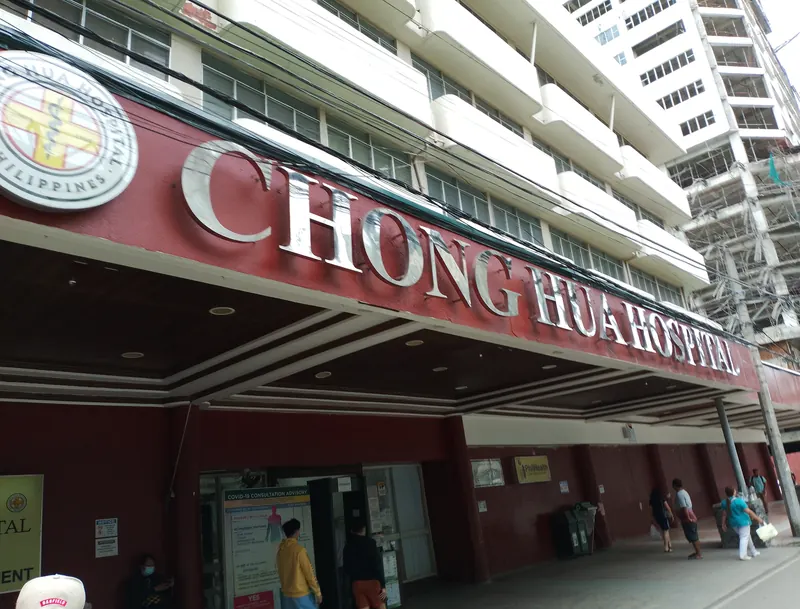
Chong Hua Hospital runs two campuses, the original on Don Mariano Cui Street and the newer one in Mandaue. It is the go-to for cardiac care, cancer treatment and high-risk pregnancy. Both campuses take the major HMOs.
Vicente Sotto Memorial Medical Center (VSMMC) on B. Rodriguez Street is the government hospital and the cheapest option by a wide margin, with consultations starting at PHP 100–PHP 300. The trade is queue length and crowded wards. The staff are competent and PhilHealth covers most of a bill here rather than a slice of it.
Perpetual Succour Hospital on Gorordo Avenue in Lahug is smaller, known for OB-GYN and maternity, and is the closest private hospital to IT Park. For the IT Park corridor it is the fastest option for a non-critical emergency.
UCMed (University of Cebu Medical Center) on Ouano Avenue in Mandaue is a newer tertiary hospital and a credible fifth option if you live in Mandaue, Subangdaku, or along A.S. Fortuna. The ER runs 24/7 and the facility has imaging, oncology, dialysis and a cardiovascular centre. UCMed also operates a free online charity teleconsultation program through its social service unit, screened by a resident physician at the first consult, which is genuinely underused by renters on a tight budget.
Cebu Provincial Hospital (CPH) in Danao is the public backup if you live in north Cebu. Typhoon Tino flooded it in November 2025, badly enough that Médecins Sans Frontières deep-cleaned the emergency room, outpatient department, minor surgery room, isolation room, doctors’ quarters and pharmacy with the Bureau of Fire Protection before it could function normally again. It is back on its feet and remains the nearest public hospital for the northern municipalities.
Closest hospital by neighbourhood
Proximity matters more than reputation during a cardiac event or a 2 a.m. fever in a child. Here is what is actually closest, and what the drive looks like at 6pm on a weekday when A.S. Fortuna and Archbishop Reyes are both crawling.
| From | Closest private | Closest public | Peak-hour drive |
|---|---|---|---|
| IT Park / Lahug | Perpetual Succour (Gorordo) | VSMMC (B. Rodriguez) | 5–15 min to Perpetual; 20–35 min to Cebu Doctors' via Archbishop Reyes |
| Banilad / Maria Luisa | Chong Hua Mandaue | VSMMC | 15–30 min to Chong Hua Mandaue; 25–45 min to Cebu Doctors' |
| Mabolo | Chong Hua (Don Mariano Cui) | VSMMC | 10–25 min to Chong Hua; longer if crossing SRP |
| Capitol | Cebu Doctors' (Osmeña) | VSMMC | 5–15 min to Cebu Doctors'; similar to VSMMC |
| Mandaue / A.S. Fortuna | Chong Hua Mandaue or UCMed | VSMMC | 10–20 min off-peak; 35–50 min through A.S. Fortuna rush |
| Talamban | Chong Hua Mandaue or Cebu Doctors' | VSMMC | 25–45 min via Gov. M. Cuenco; longer after rain |
The cheap third tier: city-run hospitals and health centres
Between full-fare private and the Vicente Sotto queue sits a third tier: Cebu City Medical Center (CCMC) and the Cebu City Health Department clinics. City-run, for non-emergency primary care, labs and basic dentistry.
Here the record is published, and it is worth being precise about what it says. The rates in force today are the ones the City Council approved in November 2024, which sharply raised fees after fourteen years: a complete blood count went to PHP 368 from PHP 60, and routine urinalysis to PHP 263 from PHP 30 (SunStar Cebu, named secondary reporting the council session).
On 26 January 2026 a councillor endorsed an amendment to Section 67 of the city’s Omnibus Tax Ordinance that would cut those fees back: medical certificate to PHP 50, oral prophylaxis to PHP 250, CBC to PHP 140, urinalysis to PHP 135, whole-abdomen MRI to PHP 15,858. It was referred to the Committee on Laws and the Committee on Budget and Finance (SunStar Cebu, 26 Jan 2026).
Either way the point stands: for routine bloods or a basic clean, walking into the city health office instead of defaulting to a private hospital lab is real money, and almost nobody does it.
Telemedicine: when you don’t need to leave the apartment
Telemedicine works in the Philippines in 2026 and covers most non-urgent situations. KonsultaMD, HealthNow, TelehealthPH, SeeYouDoc and Doctor Anywhere all take Philippine cards, GCash and Maya. Consults run PHP 200 to 700, with subscription tiers pulling the per-visit cost down if you consult monthly.
Good for: prescription refills, post-visit follow-ups, minor rashes and infections, diabetes and hypertension reviews, sleep problems, and almost all mental-health check-ins. Useless for: anything needing hands-on examination, imaging, labs or IV treatment.
Two local options matter for Cebu specifically. UCMed’s free online charity teleconsultation program is worth knowing about before you pay for a first subscription. Recovery Hub Philippines in Mandaue runs video counselling with Cebu-based psychologists, which solves the English-speaking-therapist problem for remote workers who would rather not drive to Gorordo.
Most local HMOs now fold teleconsults into the basic benefit. Ask before paying out of pocket, particularly on a Maxicare, MediCard or Intellicare plan through a BPO employer.
What common medical services cost
Out of pocket, at a private hospital, with no insurance. Public rates run far below these.
| Category | Range | Notes |
|---|---|---|
| General consultation | ₱500–₱1,500 | Outpatient, general practitioner |
| Specialist consultation | ₱800–₱2,500 | Cardiologist, dermatologist, ENT |
| ER visit (total bill) | ₱3,000–₱15,000 | Assessment + diagnostics + basic treatment |
| Basic lab panel (CBC, urinalysis) | ₱500–₱1,500 | Walk-in lab, results same day |
| X-ray (chest) | ₱500–₱1,200 | |
| Ultrasound | ₱1,500–₱3,500 | |
| CT scan | ₱8,000–₱20,000 | Depends on body area |
| Private room (per night) | ₱3,000–₱8,000 | Cebu Doctors' / Chong Hua |
| Ward bed (per night) | ₱800–₱2,000 | Shared room, 4-6 beds |
ER visits compound. The initial fee covers assessment and facility use. Everything after that is itemised: each lab, each drug administered, each specialist who looks at you, each procedure. A laceration or an allergic reaction lands around ₱3,000–₱8,000. Add imaging, IV fluids and a few hours of observation and you are at ₱10,000–₱15,000 or beyond.
Outpatient care is genuinely cheap by Western standards, and that gap is why a steady stream of foreigners fly in for planned dental, eye and elective work rather than treating it at home. If you want to run the comparison against your own currency, do not trust a figure typed into an article: the BSP reference rate is ₱62.49/USD (BSP RERB, 10 Sep 2026) and the full series is published at /data/php-fx-rates. Divide the peso ranges above by that and you have your answer, correct on the day you read it.
Many doctors take appointments through NowServing, which cuts the waiting-room time.
Lab work is the cheapest line on the page. A CBC costs PHP 200–PHP 500 at a standalone lab such as Hi-Precision or Healthcare Diagnostics. Hospital labs charge more for the same panel and are worth it only if you are already on site.
Budgeting for healthcare, monthly
The one-off PHP 500 consult is not the thing to budget for. The thing to budget for is the PHP 40,000 bill on a Sunday.
| Category | Range | Notes |
|---|---|---|
| Solo BPO worker (employer HMO) | ₱500–₱2,000 | Premium covered by employer; budget covers copays, meds, dental |
| Solo remote worker (self-paid mid-HMO) | ₱1,800–₱5,500 | Mid-tier HMO amortised + meds + one dental visit a year |
| Couple (both mid-HMO, no kids) | ₱3,500–₱9,000 | Two mid-tier HMOs + shared dental |
| Couple with 1 child (dependent HMO) | ₱5,500–₱13,000 | Family plan or 2 adult + 1 dependent, paediatric visits |
| Retiree 60+ (no employer coverage) | ₱6,000–₱18,000 | International or premium local plan + chronic meds + PhilHealth gap |
| Monthly healthcare cost | ₱17,300–₱47,500 |
The BPO HMO gap window. If you work at Accenture, Teleperformance, Concentrix, JPMorgan, Sutherland or TaskUs in IT Park, an HMO almost certainly comes with the job, either from day one or after probation. Ask in the interview. If you are switching employers, check the handover window: some new hires go one or two months uncovered during onboarding, which is precisely when a new-city stomach bug finds them.
The self-paid retiree gap. PhilHealth alone will not make you whole at Cebu Doctors’ or Chong Hua. Plan for a higher-tier HMO (if an insurer will take you past 60, which is a real filter) or an international plan that underwrites seniors. Premiums, caps, age bands and named providers are the insurance guide’s job, not this page’s. And the gap widens again if care stops being episodic: no HMO in this market pays for daily assistance at home or a residential bed, which is a separate budget covered in elder care and nursing homes.
Major procedures: what you are really insuring against
Routine care is not why you carry cover. This is.
| Category | Range | Notes |
|---|---|---|
| Normal delivery (3–4 days) | ₱30,000–₱80,000 | Room, anaesthesia, paediatrician |
| Cesarean section (5–7 days) | ₱60,000–₱150,000 | Package pricing varies by hospital |
| Appendectomy | ₱60,000–₱180,000 | Laparoscopic at the top of the range; open surgery lower |
| Cataract surgery (per eye) | ₱25,000–₱70,000 | PhilHealth case rate covers a portion |
| Cardiac angioplasty + stent | ₱250,000–₱500,000 | Single stent; multi-vessel runs higher |
| ICU bed (per night) | ₱15,000–₱30,000 | Before medications and specialist fees |
One cardiac event or a complicated delivery clears the annual cap on a mid-tier HMO on its own. The insurance strategy guide walks through how PhilHealth, HMO and international cover stack against bills like these, and the bill negotiation guide covers what to do once one has already landed.
PhilHealth for a foreigner: three branches, not one
This is where nearly every English-language page about the Philippines goes wrong, including, until this revision, ours. There is no single PhilHealth answer for foreigners. There are three, and which one applies to you turns on your visa and your employment status.
| Who you are | What you pay | Authority |
|---|---|---|
| Employed on a formal PH contract (e.g. 9(g)) | 5% of monthly basic salary, PHP 10,000 floor to PHP 100,000 ceiling — so PHP 500 to PHP 5,000 a month, split 50/50 with your employer | PhilHealth Circular 2020-0005, restated in Advisory 2025-0002; rate unchanged for 2026 |
| SRRV retiree (PRA) | PHP 15,000 a year, flat | PhilHealth Circular 2017-0003, still printed in the PhilHealth Citizen's Charter 2026 |
| Any other foreign resident (ACR I-Card, not formally employed) | PHP 17,000 a year, flat | Same circular; same 2026 Citizen's Charter entry |
The caveat worth publishing. The only issuance that sets the flat PHP 15,000 / PHP 17,000 amounts is PhilHealth Circular 2017-0003, which predates the Universal Health Care Act. PhilHealth has never issued a post-UHC circular restating or re-pricing the foreign-national category. It survives as an unrepealed 2017 circular whose fee PhilHealth still prints in its 2026 Citizen’s Charter, and RA 11223 is silent on foreigners. Expect variation between local offices, and confirm the figure at the counter before you pay. That is not us hedging; that is the actual state of the published rule.
What it covers. Inpatient hospitalization at case rates rather than actual cost, selected outpatient procedures, maternity, and some high-cost illness packages. At VSMMC it covers most of a bill. At Cebu Doctors’ it covers a fraction of one. It is a floor, not a plan.
Enrolling voluntarily. You need long-term status (SRRV, SIRV, 9(g), or another resident visa); a tourist stamp does not qualify. Walk into a PhilHealth Local Health Insurance Office with your passport, visa page, ACR I-Card and two copies of the PhilHealth Member Registration Form, downloadable from philhealth.gov.ph. Pay at the office, at an accredited bank, or online once your PIN issues. Allow a week or so before coverage is usable.
HMO and international cover, in one paragraph each
An HMO is the standard answer for anyone working here, and the practical advantage over PhilHealth is not the price, it is the mechanism: you present a card at an accredited hospital and the hospital bills the HMO. No cash at the desk for covered services. Maxicare, MediCard and Intellicare are the large three, and Cebu Doctors’ and Chong Hua sit in most networks. The catch is the annual cap, which is low by international standards and which a single surgery can exhaust.
International plans (Pacific Cross, AXA, William Russell, Cigna Global) exist for the cases an HMO cannot carry: retirees who cannot get employer cover, pre-existing conditions written in with loading, and high limits for serious illness. Many reimburse rather than pay direct, which means you front the money; Pacific Cross is the common exception and behaves like a local HMO at many Philippine hospitals.
Premiums, tiers, caps and age bands change every year and belong on one page, not five. They live in the insurance guide. This page will not restate them, because the last time it did, the two pages drifted apart and contradicted each other.
Medical evacuation. If you need moving to Manila or Singapore for something Cebu cannot do, an air ambulance is quoted per case, not priced from a schedule, and published operator quotes range so widely that repeating any single figure here would be false precision. We are not going to invent one. What you can do is concrete: if you are 60+ and settling here, read the medevac clause of the policy you are about to sign, find the cap, and satisfy yourself it is a real number rather than a bullet point.
Pharmacy, dental, mental health
Pharmacy. Generics are cheap and branded equivalents cost several times more for the same compound; the Generics Act requires the pharmacist to tell you the generic option exists, and asking is free money. The one thing to sort in your first month is a Philippine prescription: controlled substances need an S2 yellow-pad script from a Philippine-licensed doctor, and a foreign prescription will not fill them. Mercury Drug, Watsons, and Rose Pharmacy chains run 24-hour branches across the city, most now deliver, and generics routinely cost a fraction of the branded equivalent for the same compound.
Dental. Quality is good, prices are a fraction of Western ones, and the spread between a neighbourhood clinic and a hospital dental department is wide. Some HMO plans cover a cleaning or two a year; most other dental work is out of pocket. Named clinics, and 2026 pricing for cleaning, fillings, root canal, crowns and implants, are in the dental care guide.
Mental health. English-speaking psychologists and psychiatrists practise in Cebu, though the bench is thinner than Manila’s. Private-practice sessions typically run ₱1,500–₱2,500, and psychiatrists who can prescribe charge in the same band. Tahanan Mental Health Services on Gorordo Avenue runs on-site and online sessions, Inner Peace PH is a private clinic in the city, and the VSMMC psychiatry department is the low-cost route if you can absorb the wait. Many practitioners work over Zoom, which suits remote workers who want privacy; TherapyRoute lists credentials and fee ranges. HMO coverage of psychiatry is patchy and coverage of psychotherapy is rarer still. Check the policy, not the brochure.
Seasonal risks: when to expect trouble
Dengue. Central Visayas logged 5,880 dengue cases and 10 deaths from 1 January to 14 June 2025, a 3% rise on the same window in 2024, per DOH-7 figures presented at a June 2025 forum. Cebu Province carried 2,936 of them, Cebu City 999, Lapu-Lapu 378 and Mandaue 289, and children aged five to ten were nearly a third of all cases (SunStar Cebu, named secondary reporting DOH-7). That is the sourced picture. An earlier version of this page said Cebu City cases had jumped 130% year-on-year and that “the provincial total passed 5,800”; the second half of that was wrong (5,880 is the regional count, not Cebu province’s), and the first half could not be re-verified at a retrievable source, so both are withdrawn rather than restated.
Practically: clear standing water around your unit, use repellent at dawn and dusk, and sleep under aircon or a net. Cebu clinicians routinely advise a same-day CBC for a persistent fever during dengue season, because the platelet count is what tells you whether this is a nuisance or an admission. The condo dengue playbook covers where it actually breeds and which signs need an ER.
Typhoons (June–December). Cebu is not typhoon-free. Odette (December 2021) and Tino / Kalmaegi (November 2025) both put hospitals on generators and cut power across most of the metro. During Tino the Department of Health placed itself on a nationwide Code White alert to speed medical deployment into the Visayas, and Cebu Provincial Hospital in Danao flooded badly enough to need MSF-supported deep-cleaning before it could resume. Restoration in both storms took days, not hours. Assume a named storm means a week of disrupted hospital access, not an inconvenient afternoon.
Respiratory illness around Sinulog (January). Crowds and heat spike upper-respiratory infections every January. Stock paracetamol, antihistamines and ORS before the weekend, because ERs fill through mid-week.
Compound events. The northern Cebu earthquake in late 2025 overlapped with Tino, cutting roads and power at the same time in Bogo, Borbon and parts of the metro. Do not plan for one hazard at a time. Keep the go-bag packed through the wet half of the year.
Typhoon and emergency prep
Which hospitals stayed up. Cebu Doctors’ and Chong Hua (both campuses) kept emergency services running on generators through the worst of both storms, with elective procedures paused. VSMMC stayed open and triaged hard. Perpetual Succour kept its ER active. The failure mode is rarely the hospital. It is the road to it.
Corridors that block. Mahiga Creek and Guadalupe River overflow can cut parts of A.S. Fortuna, Banilad-Talamban, and sections of V. Rama and N. Bacalso. Butuanon River affects the Mandaue approach. If you live in Banilad or Talamban under a typhoon watch, assume the drive to Chong Hua Mandaue could take hours or be impossible for a day. Pick your fallback hospital before the storm, not during it.
Pre-storm checklist.
- Two to four weeks of prescription medication, kept dry
- Paracetamol, ORS, antihistamines, basic wound care
- Photos of HMO card, PhilHealth ID, passport, current prescription list, in phone and cloud
- Cash: ATMs go down fast when the power drops
- Charged power banks and a car charger
- Bottled or boiled drinking water (MCWD supply drops across wide areas)
Handling a medical emergency
| Situation | Go to | Why |
|---|---|---|
| Life-threatening (chest pain, stroke, major trauma) | Nearest private ER, or 911 | Private ERs treat first and bill after; Cebu Doctors' and Chong Hua run cardiac and stroke teams |
| Urgent, not critical (fever, laceration, allergic reaction) | Private ER, off-peak if you can | Shorter waits early morning or early afternoon |
| Non-urgent, uninsured, tight budget | VSMMC outpatient | Consultations start at PHP 100–300; long waits, competent staff |
| Typhoon or flood blocking roads | Closest operational hospital, not your preferred one | Tino and Odette both cut the metro's usual corridors; nearest beats best |
| After a Sinulog crowd injury | Perpetual Succour or VSMMC (whichever is closest to the route) | Cebu Doctors' and Chong Hua often hit capacity from the same event |
Bring: valid ID, HMO card, PhilHealth number, current medication list, emergency contact. The HMO card is what buys you cashless treatment at an accredited hospital. Without it you pay and claim later.
Uninsured: a private ER will not turn away an emergency, and under RA 10932 it may not demand a deposit first. You will still get the bill, at roughly ₱3,000–₱15,000 for the visit and ₱3,000–₱8,000 a night on top for a private room. VSMMC is the affordable route for anything not life-threatening. The full walkthrough, including ambulance versus Grab and the billing flow, is in the emergency room guide.
Set it up before you need it
In your first month in Cebu: sort PhilHealth or activate the HMO, save 911 and the ER lines you looked up yourself, locate the nearest private and public hospital to your unit, register with a GP, and stock two weeks of any regular medication. Finding an English-speaking doctor is not the obstacle newcomers expect it to be, since physicians at Cebu Doctors’, Chong Hua, Perpetual Succour and UCMed all train and practise in English, and the telemedicine platforms above let you screen one before you commit to a visit. Access is good here. Navigating it cold, mid-crisis, is the hard part, and that is the part you can remove in an afternoon.
For how healthcare sits inside a full monthly budget, see the cost of living guide and the 20k–30k a month budget guide. The neighborhoods guide maps which hospital is closest to each area, and the IT Park and Lahug guide covers Perpetual Succour proximity for BPO workers.
How we source, date and re-verify every figure on this site, and what we do when we cannot, is set out in the methodology. The FX series used above is published in full, with its BSP bulletin provenance, at /data/php-fx-rates.
FAQ
Frequently asked.
How much does a doctor visit cost in Cebu City?
Do expats need PhilHealth in Cebu?
Which is the best hospital in Cebu City?
How much does an ER visit cost in Cebu?
Can I see a doctor in Cebu without leaving the house?
Data note. Prices, rates, and details are verified as of publication and may change. Always confirm with the listed provider or landlord before committing. This article is informational, not financial, legal, or immigration advice. Full disclaimer.