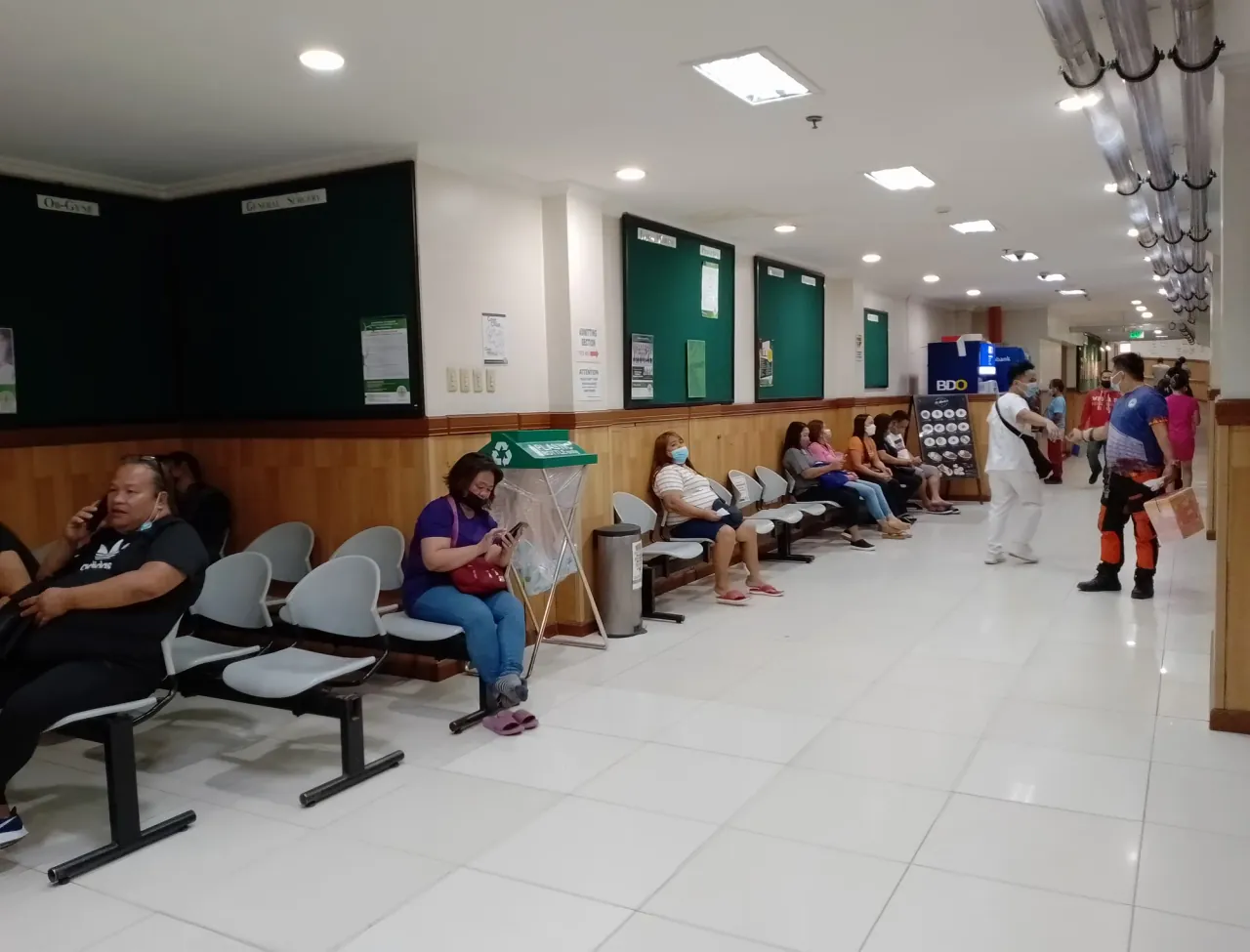
The hospital bill in the Philippines has one number in it you can look up and one you cannot. PhilHealth’s case rate is published, fixed, and paid to the hospital whatever the sticker says. The sticker itself is not published by any private hospital in Cebu. Everything useful you can do about a Cebu hospital bill happens in the gap between those two facts, and the window is the hour between the diagnosis and the admission consent.
The five-minute admission call
The window opens the moment you have a diagnosis and a recommended admission, and it closes when you sign the consent. Inside it, the billing department will talk to you on the phone. Afterwards you are a patient with a wristband and no leverage.
Five questions, in order:
- “What’s the PhilHealth case rate for this diagnosis or procedure?” The clerk reads it off a schedule. It is a fixed peso amount, not a percentage, and it is the one part of the bill that behaves predictably.
- “Does my HMO have a Letter of Authorization on file for this admission?” If not, call the HMO’s 24-hour line and push the LOA before you arrive. Without it the hospital treats you as cash-pay.
- “Which room classes are available, and which is the cheapest that doesn’t void PhilHealth coverage?” Basic accommodation is what PhilHealth’s no-balance-billing and co-payment-cap rules are written around. Upgrading is a decision, not a default.
- “With PhilHealth and HMO on file, do you waive the admission deposit?” An accredited HMO with a live LOA usually triggers the waiver. Without an HMO, ask what a reduced deposit looks like against the PhilHealth Member Data Record.
- “What’s the estimated out-of-pocket after PhilHealth and HMO for this case, in writing?” Get a peso range on paper or in an email. That document is what you measure the discharge bill against, and it is the reason the discharge conversation is short.
What PhilHealth actually pays
PhilHealth pays the hospital a fixed amount per diagnosis or procedure. The case rate covers basic-accommodation room and board, common formulary medications, a defined professional-fee component for the surgeon and anesthesiologist, and routine ancillaries. Anything above that (a private room, branded non-formulary drugs, extra diagnostics) lands on the patient or the HMO.
These are read directly off PhilHealth’s own schedules. The First Case Rate splits into a Health Facility Fee and a Professional Fee, and both halves are published:
| Case | Code | Case rate | Hospital / doctors split |
|---|---|---|---|
| Laparoscopic appendectomy | RVS 44970 | PHP 46,800 | 28,080 / 18,720 |
| Appendectomy (open) | RVS 44950 | PHP 46,800 | 28,080 / 18,720 |
| Caesarean section, primary | RVS 59513 | PHP 58,000 | package rate |
| Normal spontaneous delivery | NSD benefit | PHP 29,000 | package rate |
| Pneumonia, moderate risk | ICD J18.x2 | PHP 29,250 | 20,475 / 8,775 |
| Essential hypertension (admission) | ICD I10.9 | PHP 17,550 | 12,285 / 5,265 |
| Intracoronary stent, single vessel | RVS 92980 | PHP 59,085 | 26,325 / 32,760 |
The case rate is paid to the hospital, not to you. It shows up as a “PhilHealth Benefit” deduction on the statement of account at discharge. Two 2025 rule changes are worth knowing before you argue with anyone about it: PhilHealth lifted the 45-day annual benefit limit (Circular 2025-0007) and lifted the single-period-of-confinement rule (Circular 2025-0015, Rev. 1), so a second admission inside 90 days for the same condition no longer collides with the first.
Stacking PhilHealth and an HMO
The order is fixed: PhilHealth pays its case rate first, the HMO pays the balance up to its remaining annual limit, and the patient pays whatever is left. Nothing about that order is negotiable, which is why the leverage sits earlier, in what the bill contains.
Take the appendectomy. PhilHealth’s contribution is ₱46,800 (Jan 2025), and it does not move: not with the room class, not with the surgeon, not with the length of stay. If the gross bill comes in at PHP 100,000, PhilHealth has covered a bit under half of it. If the surgeon’s fee alone is PHP 60,000, PhilHealth’s professional-fee component of PHP 18,720 covers under a third of that one line, and the rest is either an HMO claim or your money.
So the arithmetic you can actually do before admission is:
out-of-pocket = (written estimate from billing) − 46,800 − (HMO’s remaining annual limit)
Every term on the right is obtainable in one afternoon of phone calls. The first is the one people skip, and it is the only one that varies by hospital, by surgeon, and by room. A mid-tier corporate HMO plan with a six-figure annual limit and an LOA on file will usually absorb the entire remainder of an uncomplicated appendectomy, leaving the room-upgrade differential and any non-formulary medication. Without an HMO, that remainder is the whole out-of-pocket, and it is worth knowing its size before the incision rather than after.
Foreigner PhilHealth enrollment
Eligibility turns on visa class, and so does the premium. The site’s canonical treatment of this lives in the Cebu health insurance primer; the short version:
- Employed on a formal Philippine contract (typically 9g): you are an ordinary Direct Contributor. 5% of monthly basic salary, income floor PHP 10,000 and ceiling PHP 100,000, split with the employer (PhilHealth Circular 2020-0005, restated in Advisory 2025-0002; the rate is unchanged for 2026). PhilHealth Circular 2017-0003 expressly excludes this group from the flat foreign-national schedule below.
- SRRV retiree: a flat PHP 15,000 a year.
- Any other resident foreigner on an ACR I-Card, not formally employed (13a spouse, self-paying long-stayer): a flat PHP 17,000 a year.
- 9a tourist without an ACR I-Card: no enrollment route. The foreign-national registration category is built on the ACR I-Card.
Premiums are paid through the PhilHealth Member Portal, accredited banks, and the usual payment centres. For how declared income interacts with a foreigner’s tax position, see the tax for foreigners primer.
Cebu’s hospital trio
| Chong Hua | Perpetual Succour | UCMed | |
|---|---|---|---|
| Campus | Don Mariano Cui St (Fuente) + Mandaue | Gorordo Ave | Ouano Ave, Mandaue |
| Room / surgical tariff | Not published | Not published | Not published |
| PhilHealth accepted | Yes | Yes | Yes |
| Major HMO network | All major HMOs | All major HMOs | All major HMOs |
| Depth | Cardiac, oncology, complex surgery | Routine surgery, deliveries, general medicine | Newer build, imaging-heavy, ISO 9001:2015 |
Chong Hua Hospital is the largest private hospital in Cebu and the deepest on sub-specialty care. The Fuente campus on Don Mariano Cui Street handles most of the cardiac, oncology, and high-complexity surgical volume; the Mandaue campus is a full-service satellite with lighter waiting times. English-fluent billing, broad HMO accreditation.
Perpetual Succour Hospital on Gorordo Avenue is the routine-admission hospital: general surgery, deliveries, general medicine, and the fastest ER from IT Park and Lahug. Its surgeons’ professional fees and elective package rates are quoted per case, not published, so confirm both with the hospital directly.
University of Cebu Medical Center (UCMed) on Ouano Avenue in Mandaue opened in 2015 and is the newest of the three, with the imaging and cardiovascular build-out to match. It publishes an ISO 9001:2015 quality-management certification (TÜV Rheinland) and American Heart Association training-centre status; it does not list Joint Commission International accreditation, and an earlier version of this page wrongly said it did. For the wider hospital landscape, including the public options, see the Cebu hospital cost rundown.
The levers that actually move the bill
Separately from the levers: a hospital’s billing office or social-services unit will accept a written request to reduce the patient’s portion of the bill, and for catastrophic cases the PCSO Cebu branch takes medical-assistance applications against an itemised statement of account, a diagnosis, and an ID. PCSO assesses each case individually and publishes no fixed ceiling for it. Neither of these is a schedule you can plan around, and this page is not going to pretend either is a number.
The no-LOA trap
The failure mode repeats: a foreigner arrives at the ER with a condition that is not life-threatening but is admissible, signs cash-pay paperwork under stress, pays a deposit, and then spends three months chasing reimbursement. The fix is one phone call, made before anything is signed. For the ER side of this, including ambulance-versus-Grab and the triage flow, see the Cebu ER walkthrough.
When cash is the only option
No PhilHealth, no HMO, no international policy. The levers shrink but do not vanish.
- Ask for the package rate. Elective surgeries are usually quoted as a bundle (theatre, surgeon, anesthesia, room, standard medication) and the bundle is normally cheaper than the same care billed line by line. Get both quotes and compare them.
- Negotiate the deposit at admission. The admissions supervisor has discretion, and a credible income showing is what it turns on.
- Ask the billing supervisor about a cash settlement discount on the out-of-pocket portion at discharge. Some hospitals operate one. None of them publish it, so the only way to find out is to ask.
- Prescribe generic. The Generics Act requires the generic name on every prescription, and the pharmacist must offer the generic option. Ask the attending physician to write generics onto the discharge script before you leave the ward.
Foreign insurance (Cigna Global, Allianz Care, Bupa Global, William Russell) generally operates on reimbursement rather than direct settlement at the Cebu hospitals. Pre-arrange the documentation before admission: itemised statement of account, ICD-10 code, clinical abstract, official receipts.
The closing constraint
Two windows, and both are short. The hour before you sign the admission consent, and the ten minutes at the discharge cashier before you pay. In between, you are a patient and the bill is being written by other people. PhilHealth’s number you can look up today. The hospital’s number you have to ask for. Ask for it in writing, and ask before the wristband goes on.
FAQ
Frequently asked.
Can a foreigner enroll in PhilHealth in 2026?
How much does PhilHealth pay for an appendectomy in Cebu?
Which is cheaper, Chong Hua or Perpetual Succour?
Will my HMO cover a Cebu hospital if I'm enrolled in Manila?
What happens if I refuse to pay the deposit at admission?
Can I negotiate the doctor's fee at a Cebu private hospital?
Data note. Prices, rates, and details are verified as of publication and may change. Always confirm with the listed provider or landlord before committing. This article is informational, not financial, legal, or immigration advice. Full disclaimer.